Maximizing Power with Your Padel Racket: Technique Meets Equipment
Author: Carlos Rodriguez
Author: Carlos Rodriguez
Introduction
Power in padel is the result of a perfect marriage between your technique and your equipment. Many players struggle to generate the power they want, often blaming their racket when the issue is actually a combination of equipment choice, technique, and understanding how the two work together. Learning to maximize power requires understanding both how racket features contribute to power generation and how to adjust your technique to unlock that potential.
The relationship between equipment and technique is complex. A powerful racket won't help if your technique doesn't allow you to harness that power effectively. Conversely, excellent technique can generate significant power even with a control-focused racket, but the right equipment can amplify your efforts dramatically.
In this comprehensive guide, we'll explore:
- How racket features contribute to power generation
- Technique adjustments for different racket types
- The balance between equipment and skill in power development
- Common power generation mistakes and how to avoid them
- Training tips for developing power with your equipment
- Low sweet spot location creating leverage
- High balance point concentrating weight in the head
- Smaller head size focusing energy transfer
- Weight distribution optimized for power generation
- Medium sweet spot location
- Balanced to high balance points
- Versatile weight distribution
- Good power with maintained control
- High sweet spot requiring different technique
- Lower balance points
- Larger sweet spot for consistent contact
- Power comes from racket head speed and technique
- Weight concentration in the head
- Leverage effect on swings
- Momentum generation
- Reduced need for maximum racket head speed
- Moderate weight distribution
- Versatile power generation
- Technique and equipment both contribute
- Good power with control
- Weight toward handle
- Power from racket head speed
- Technique compensates for lower leverage
- Control-focused with power potential through technique
- Stiffer response to ball impact
- More energy transfer to the ball
- Less energy absorption
- Increased power potential
- Moderate stiffness
- Good energy transfer
- Some absorption for control
- Versatile power characteristics
- More energy absorption
- Softer feel
- Power from technique
- Control and comfort priority
- Increased mass behind the ball
- More momentum in swings
- Greater energy transfer
- Physical demand for handling
- Faster racket head speed possible
- Technique-dependent power
- Less physical demand
- Speed compensates for mass
- Enough weight for power
- Manageable for racket head speed
- Personal strength and preference
- Technique development level
- Full weight transfer through the shot
- Complete rotation and follow-through
- Maximum leverage utilization
- Commitment to each shot
- Contacting the ball lower in your strike zone
- Using body rotation for power
- Taking advantage of leverage
- Precise timing for optimal contact
- Taking control of points
- Playing aggressively
- Positioning to finish points
- Using power effectively
- Not over-swinging (power is already there)
- Controlling power through technique
- Using power strategically
- Maintaining control despite power
- Adapt swing to the situation
- Use full swings when power is needed
- Compact swings for control
- Balance power and control
- Contact at various heights
- Adaptation to different shots
- Using sweet spot effectively
- Versatile power generation
- Versatile positioning
- Adapting to situations
- Mixing power and control
- Supporting various playing styles
- Power when needed
- Control when required
- Adaptation to situations
- Versatile approach
- Generating power through speed
- Fast, controlled swings
- Technique compensates for lower leverage
- Speed and timing crucial
- Contacting ball at optimal height
- Using racket's natural leverage
- Taking advantage of large sweet spot
- Consistent contact for power
- Power through placement
- Using angles effectively
- Consistent, controlled power
- Technique-driven power generation
- Building points with consistency
- Creating opportunities
- Finishing when opportunities arise
- Patient power development
- Shape determines leverage
- Balance affects power generation
- Materials influence energy transfer
- Weight impacts power capability
- Maximum power potential
- Technique requirements
- Physical demands
- Performance characteristics
- Power potential
- Leverage advantages
- Material benefits
- Design optimizations
- How much power you can generate
- Ability to control power
- Consistency of power generation
- Effective use of equipment
- Racket head speed generation
- Power through strength
- Endurance for consistent power
- Ability to handle demanding rackets
- Power generation consistency
- Timing for optimal contact
- Shot selection for power
- Effective power use
- Match your current ability
- Provide room to grow
- Support your development
- Don't overwhelm your technique
- Generate more power
- Control power effectively
- Use equipment optimally
- Maximize your potential
- Consider more powerful rackets
- Upgrade to match ability
- Support advanced techniques
- Maximize performance
- Reduces control
- Wastes energy
- Creates timing issues
- Doesn't utilize racket's power potential
- Let the racket do the work (if it's powerful)
- Focus on technique and timing
- Use efficient, controlled swings
- Trust your equipment
- Misses optimal contact zone
- Reduces power transfer
- Creates inconsistent results
- Wastes racket's power potential
- Learn your racket's sweet spot location
- Adjust contact points accordingly
- Practice consistent contact
- Use racket's leverage effectively
- Can't control powerful rackets
- Technique can't unlock potential
- Creates frustration
- Limits development
- Choose rackets matching your ability
- Progress gradually
- Match equipment to style
- Support skill development
- Limits power potential
- Reduces consistency
- Prevents improvement
- Wastes equipment benefits
- Develop fundamental technique
- Practice power generation
- Improve timing and contact
- Combine equipment and skill
- Creates errors
- Reduces effectiveness
- Limits point construction
- Wastes power advantage
- Balance power and control
- Use power strategically
- Maintain technique under power
- Control power application
- Full swing mechanics
- Weight transfer exercises
- Rotation and follow-through
- Consistent power generation
- Practice at optimal heights
- Use your racket's sweet spot
- Develop timing and feel
- Consistent power application
- Vary power levels
- Maintain control with power
- Strategic power use
- Balanced approach
- Core strength for rotation
- Arm strength for racket head speed
- Leg strength for weight transfer
- Overall power development
- Full swing capability
- Rotation range
- Follow-through completion
- Injury prevention
- Cardiovascular fitness
- Muscular endurance
- Consistent power generation
- Long-match performance
- Understand its characteristics
- Learn its power potential
- Practice with it regularly
- Develop feel and confidence
- Start with controlled power
- Increase as technique improves
- Match power to ability
- Support development
- Compare power characteristics
- Find optimal match
- Understand differences
- Make informed choices
- Overhead smashes
- Powerful volleys
- Aggressive returns
- Finishing shots
- Appropriate situations
- Point construction
- Opponent weaknesses
- Match strategy
- Throughout matches
- Under pressure
- In various situations
- With confidence
- Racket features set power potential: Shape, balance, core material, and weight all contribute to how much power your racket can generate.
- Technique unlocks equipment potential: Your skill level determines how effectively you can use your racket's power characteristics.
- Different rackets require different techniques: Diamond shapes need committed swings and lower contact points, while round shapes require racket head speed and higher contact points.
- Balance equipment and skill: Choose rackets that match your ability while developing technique to maximize power generation.
- Avoid common mistakes: Over-swinging, wrong contact points, equipment mismatch, and ignoring fundamentals all limit power development.
- Focused training develops power: Technique drills, physical development, equipment-specific practice, and match application all contribute to power improvement.
- How Your Racket Shape Affects Your Playing Technique
- Understanding Padel Racket Ratings: Power, Control, and More
- Advanced Padel Racket Selection Guide
- Browse All Rackets
- View All Guides
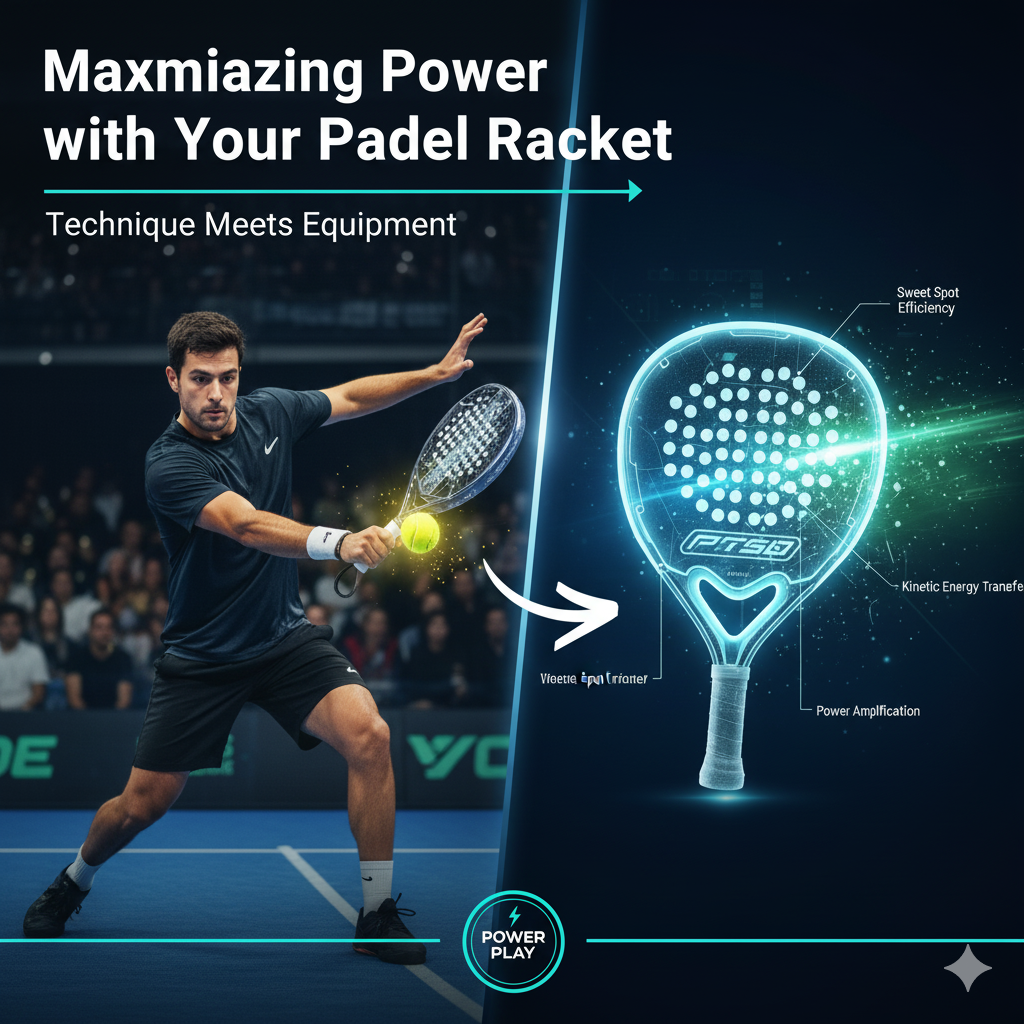
!Maximizing Power with Your Padel Racket: Technique Meets Equipment
How Racket Features Contribute to Power
Understanding how your racket's characteristics affect power helps you choose the right equipment and use it effectively.
Racket Shape and Power
Diamond Shapes: Maximum power potential through:
Teardrop Shapes: Balanced power through:
Round Shapes: Lower inherent power but technique-dependent:
Balance Point and Power Generation
High Balance (Head-Heavy): Maximizes power through:
Medium Balance: Balanced power through:
Low Balance (Handle-Heavy): Lower inherent power, technique-dependent:
Core Material and Power
Hard Cores: Enhance power through:
Medium Cores: Balanced power and control:
Soft Cores: Lower power, control-focused:
Weight and Power
Heavier Rackets: Can generate more power through:
Lighter Rackets: Power through speed:
Optimal Weight: Balance between mass and speed:
Technique Adjustments for Different Racket Types
Your technique must adapt to your racket's characteristics to maximize power effectively.
Technique for Diamond-Shaped Rackets
Full, Committed Swings: Diamond shapes reward complete commitment:
Lower Contact Points: The low sweet spot requires:
Aggressive Positioning: Diamond shapes excel when you're:
Power Control: Managing the racket's power:
Technique for Teardrop-Shaped Rackets
Versatile Swing Styles: Teardrop shapes support various approaches:
Flexible Contact Points: The medium-high sweet spot allows:
All-Court Approach: Teardrop shapes reward:
Balanced Technique: Finding the right balance:
Technique for Round-Shaped Rackets
Racket Head Speed Focus: Round shapes require:
High Contact Points: The high sweet spot encourages:
Placement and Power: Round shapes reward:
Defensive to Offensive: Round shapes support:
The Balance Between Equipment and Skill
Understanding how equipment and skill interact is crucial for power development.
Equipment Provides Potential
Racket Characteristics: Your racket sets power potential:
Equipment Limitations: Every racket has limits:
Equipment Advantages: Rackets provide benefits:
Skill Unlocks Potential
Technique Development: Your skill determines:
Physical Development: Your physical abilities affect:
Experience and Timing: Experience improves:
Finding Your Balance
Matching Equipment to Skill: Choose rackets that:
Skill Development: Improve your technique to:
Equipment Upgrades: As skills improve:
Common Power Generation Mistakes
Avoiding common mistakes helps you develop power more effectively.
Over-Swinging
The Mistake: Trying to generate power through excessive swing force, especially with powerful rackets.
Why It Fails:
The Solution:
Wrong Contact Points
The Mistake: Contacting the ball at heights that don't match your racket's sweet spot location.
Why It Fails:
The Solution:
Equipment Mismatch
The Mistake: Using rackets that don't match your skill level or playing style for power generation.
Why It Fails:
The Solution:
Ignoring Technique Fundamentals
The Mistake: Relying solely on equipment for power without developing proper technique.
Why It Fails:
The Solution:
Power Without Control
The Mistake: Focusing solely on power without maintaining control.
Why It Fails:
The Solution:
Training Tips for Power Development
Developing power requires focused training that combines equipment understanding with technique improvement.
Technique Drills
Power Swing Development: Practice generating power through:
Contact Point Practice: Develop consistent contact:
Power Control Drills: Learn to control power:
Physical Development
Strength Training: Develop physical power:
Flexibility: Maintain range of motion:
Endurance: Maintain power throughout play:
Equipment-Specific Training
Racket Familiarization: Get comfortable with your racket:
Progressive Development: Build power gradually:
Equipment Testing: Try different rackets:
Match Application
Practice Power Shots: Develop power in practice:
Strategic Power Use: Learn when to use power:
Consistency Development: Maintain power consistently:
Key Takeaways
Related Content
Conclusion
Maximizing power with your padel racket is about understanding how equipment and technique work together. Your racket provides power potential through its design and materials, but your technique determines how effectively you can unlock and use that potential.
Whether you're using a powerful diamond-shaped racket or a control-focused round racket, the principles remain the same: understand your equipment's characteristics, develop technique that works with those characteristics, and train to improve your power generation consistently.
Remember, power without control is wasted, and the best power comes from the perfect combination of the right equipment, proper technique, and strategic application. Focus on developing both your equipment understanding and your technique, and you'll find yourself generating the power you want while maintaining the control you need.
Ready to find a racket that matches your power goals? Browse our complete racket collection with detailed reviews, power ratings, and expert recommendations. Each review includes information about power characteristics and how to maximize power with that specific racket.
Your power potential is waiting to be unlocked—the right equipment and proper technique will get you there.