The Science Behind Padel Racket Control: Understanding Feel and Precision
Author: Carlos Rodriguez
Author: Carlos Rodriguez
Introduction
Control in padel is often described as "feel" or "touch," but these terms don't fully capture what's actually happening when you achieve precise shot placement. Control is the result of complex interactions between your racket's physical properties, your technique, and how your body processes feedback. Understanding the science behind control helps you choose equipment and develop techniques that maximize precision.
Many players struggle with control, attributing inconsistent placement to poor technique when equipment characteristics may be contributing factors. Conversely, some players achieve excellent control without understanding why their racket feels so responsive. The science behind control reveals how racket features create the conditions for precision.
In this comprehensive guide, we'll explore:
- What "control" really means in padel from a scientific perspective
- How racket features affect control and precision
- The relationship between feel, feedback, and control
- Control vs power trade-offs and how to balance them
- Equipment adjustments and techniques for better control
- Consistent trajectory based on your swing
- Predictable spin generation
- Reliable placement relative to your aim
- Repeatable results with similar technique
- Predictable power output for given input
- Consistent ball speed relative to swing speed
- Reliable response to different contact points
- Stable performance across the sweet spot
- Vibration that provides information without overwhelming
- Feel that helps you sense contact quality
- Feedback that guides adjustments
- Comfort that allows consistent play
- Lateral placement (left/right)
- Depth control (short/deep)
- Height control (low/high)
- Angle creation
- Topspin generation
- Backspin application
- Side spin control
- Spin consistency
- Power modulation
- Consistent power for given input
- Power predictability
- Shot-to-shot consistency
- Largest sweet spot providing forgiveness
- High sweet spot location for consistent contact
- Balanced weight distribution for stability
- Forgiving nature reducing errors
- Medium-large sweet spot
- Versatile contact point options
- Balanced characteristics
- Good control with some power
- Smaller sweet spot requiring precision
- Lower sweet spot location
- Power-focused design
- Control through technique
- Weight toward handle for maneuverability
- Easier racket head positioning
- Quick adjustments possible
- Stable feel during swings
- Moderate weight distribution
- Versatile control characteristics
- Good maneuverability
- Stable performance
- Weight in head reduces maneuverability
- Harder to make quick adjustments
- Power-focused design
- Control through technique and strength
- More energy absorption
- Softer feel and feedback
- Reduced power for better control
- Comfortable, forgiving response
- Moderate energy transfer
- Balanced feel
- Good control with some power
- Versatile characteristics
- More energy transfer (power)
- Stiffer response
- Less forgiving
- Control through technique
- Spin generation capability
- Ball grip and release
- Consistent surface response
- Predictable ball interaction
- Consistent texture
- Reliable spin generation
- Predictable ball response
- Optimal control characteristics
- Vibration from ball contact
- Racket movement during contact
- Weight and balance sensation
- Grip security and comfort
- Racket head position
- Swing path awareness
- Contact point sense
- Follow-through feel
- Contact timing
- Swing rhythm
- Shot tempo
- Timing adjustments
- Familiarity with your racket
- Understanding racket response
- Developing sensitivity
- Building confidence
- Notice vibration patterns
- Sense contact quality
- Feel racket response
- Develop sensitivity
- Start with basic awareness
- Develop sensitivity over time
- Refine feel through experience
- Trust your developing sense
- Predictable response
- Manageable feedback
- Consistent feel
- Supportive of feel development
- Right size for your hand
- Good texture for grip
- Comfortable and secure
- Allows sensitivity
- Builds familiarity
- Develops specific feel
- Creates consistency
- Supports improvement
- More power potential
- Less forgiving
- Require precision
- Technique-dependent control
- More forgiving
- Easier to control
- Less inherent power
- Technique-dependent power
- Moderate power and control
- Versatile characteristics
- Support various styles
- Balanced approach
- Beginners: Prioritize control for consistency
- Intermediate: Balance power and control
- Advanced: Can handle power-focused with technique
- Defensive: Prioritize control
- Aggressive: Can handle power-focused
- Versatile: Balanced approach
- Some players prefer control
- Others prioritize power
- Find what works for you
- Match equipment to preferences
- Precise contact
- Consistent technique
- Proper timing
- Skill development
- Racket head speed
- Proper mechanics
- Efficient energy transfer
- Skill development
- Round or teardrop shapes
- Low to medium balance
- Soft to medium cores
- Larger sweet spots
- Higher control ratings (70-100)
- Balance with other needs
- Match to skill level
- Support your game
- How they feel in your hands
- Response to your technique
- Comfort and feedback
- Control characteristics
- Comfortable hold
- Secure grip
- Good feel
- Consistent control
- Good grip security
- Sweat management
- Comfortable feel
- Consistent hold
- Fresh grips provide better feel
- Worn grips reduce control
- Regular replacement
- Optimal condition
- Lighter for maneuverability
- Heavier for stability
- Find optimal balance
- Personal preference
- Lower balance for control
- Higher balance for power
- Find your sweet spot
- Support your style
- Practice finding it consistently
- Understand its location
- Develop feel for it
- Use it effectively
- Same contact point when possible
- Adjust for different shots
- Maintain consistency
- Build reliability
- Contact at optimal moment
- Consistent timing
- Rhythm development
- Timing adjustments
- Smooth, consistent paths
- Proper follow-through
- Balanced mechanics
- Repeatable technique
- Aim for targets
- Use angles effectively
- Control depth
- Vary placement
- Repeatable technique
- Predictable results
- Build reliability
- Develop control
- Specific placement drills
- Accuracy development
- Consistency building
- Control improvement
- Start with larger targets
- Progress to smaller targets
- Add movement and pressure
- Continue developing
- Pay attention to sensations
- Notice racket response
- Develop sensitivity
- Trust your feel
- Control is predictable response: A controlled racket responds consistently to your input, allowing precise shot placement.
- Racket features significantly affect control: Shape, balance, core material, and surface all influence how much control a racket provides.
- Feel development is essential: Developing sensitivity to racket feedback helps you achieve better control and make adjustments.
- Control and power trade off: Understanding this relationship helps you choose equipment that matches your priorities and skill level.
- Equipment choices matter: Selecting control-focused rackets and maintaining them properly supports precision.
- Technique supports control: Consistent contact, proper swing mechanics, and focused practice all contribute to control development.
- Understanding Padel Racket Ratings: Power, Control, and More
- How Your Racket Shape Affects Your Playing Technique
- Best Padel Rackets for Beginners 2025
- Browse All Rackets
- View All Guides
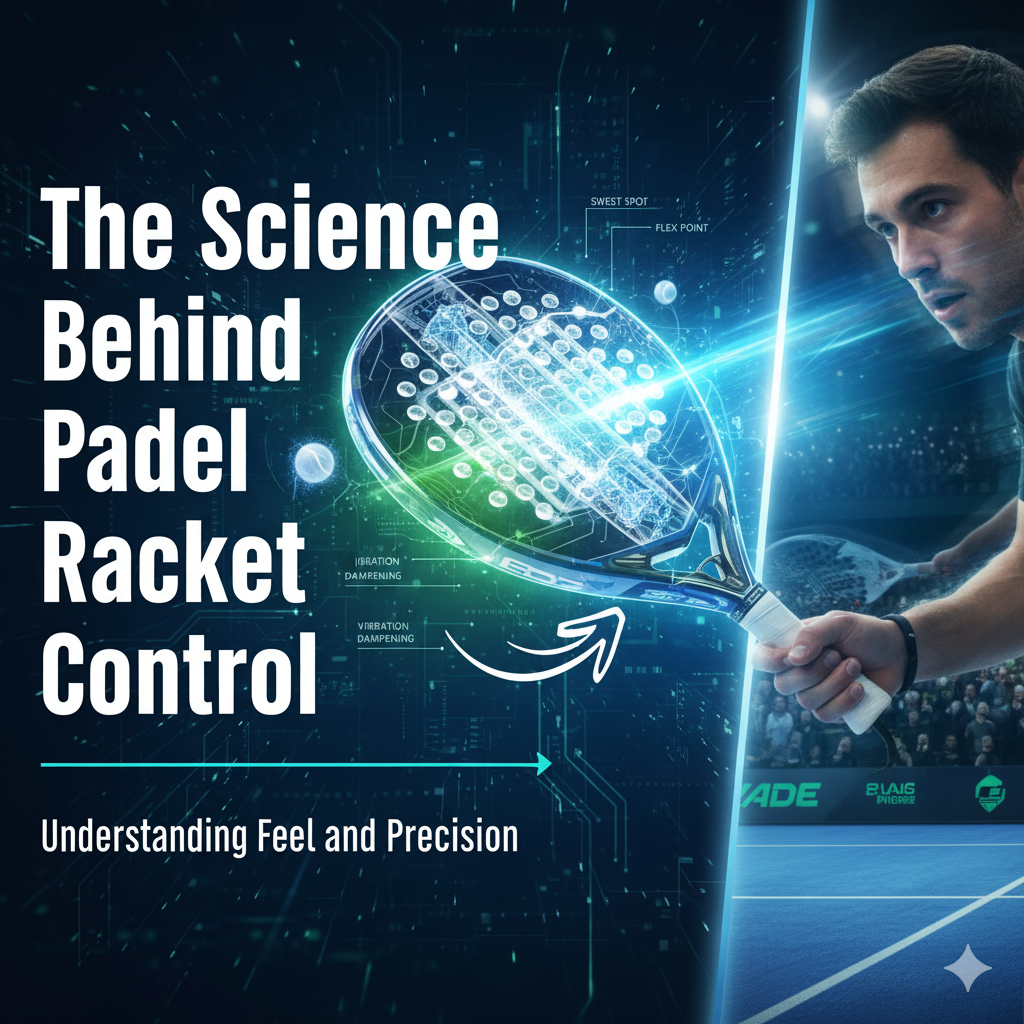
!The Science Behind Padel Racket Control: Understanding Feel and Precision
What Control Really Means in Padel
Control in padel isn't just about hitting the ball where you want—it's about consistent, predictable ball response that allows you to execute shots with precision and confidence.
The Physics of Control
Predictable Ball Response: Control means the ball responds predictably to your input:
Energy Transfer Consistency: Controlled rackets transfer energy consistently:
Vibration and Feedback: Control involves manageable feedback:
Control vs Accuracy
Control: The racket's ability to respond predictably to your input, allowing you to place shots where intended.
Accuracy: Your ability to consistently hit your intended target, which depends on both control and technique.
The Relationship: Good control makes accuracy easier to achieve, but technique is still required. A controlled racket responds predictably, but you must still aim correctly and execute properly.
Control Components
Placement Control: The ability to direct the ball to specific locations:
Spin Control: The ability to generate and control spin:
Power Control: The ability to vary and control power output:
How Racket Features Affect Control
Understanding how specific racket characteristics influence control helps you choose equipment that supports precision.
Racket Shape and Control
Round Shapes: Maximum control through:
Teardrop Shapes: Balanced control through:
Diamond Shapes: Lower inherent control, technique-dependent:
Balance Point and Control
Low Balance (Handle-Heavy): Enhances control through:
Medium Balance: Balanced control through:
High Balance (Head-Heavy): Lower inherent control, power-focused:
Core Material and Control
Soft Cores: Enhance control through:
Medium Cores: Balanced control through:
Hard Cores: Lower inherent control, power-focused:
Surface and Control
Surface Texture: Affects control through:
Surface Condition: Maintained surfaces provide:
Developing Feel and Touch
Feel is your ability to sense what's happening during ball contact, and it's essential for control development.
Understanding Feel
Tactile Feedback: What you feel in your hands:
Kinesthetic Awareness: Your sense of racket position and movement:
Temporal Feedback: Timing and rhythm sense:
Developing Feel
Regular Practice: Consistent play develops feel:
Focused Attention: Pay attention to sensations:
Progressive Development: Build feel gradually:
Equipment for Feel Development
Controlled Rackets: Rackets with good control characteristics:
Proper Grip: Grip that enhances feel:
Consistent Equipment: Using the same racket:
Control vs Power Trade-Offs
Understanding the relationship between control and power helps you make informed equipment choices.
The Fundamental Trade-Off
Power-Focused Rackets: Typically sacrifice some control:
Control-Focused Rackets: Typically sacrifice some power:
Balanced Rackets: Compromise between power and control:
Finding Your Balance
Skill Level Considerations:
Playing Style Considerations:
Personal Preferences:
Technique Compensation
Control with Power Rackets: Technique can provide control:
Power with Control Rackets: Technique can generate power:
Equipment Adjustments for Better Control
Making the right equipment choices and adjustments enhances control.
Racket Selection for Control
Choose Control-Focused Rackets: Look for:
Consider Control Ratings: Use control ratings as guidance:
Test for Feel: Try rackets to assess:
Grip Considerations
Proper Grip Size: Right size enhances control:
Grip Texture: Texture affects control:
Grip Condition: Maintain grips for control:
Customization Options
Weight Adjustments: Fine-tune weight for control:
Balance Modifications: Adjust balance if possible:
Techniques for Better Control
Developing technique that supports control is essential for precision.
Contact Point Consistency
Find Your Sweet Spot: Learn your racket's sweet spot:
Consistent Contact: Develop consistent contact:
Timing Development: Improve timing for control:
Swing Mechanics for Control
Controlled Swings: Swings that support control:
Placement Focus: Focus on placement:
Consistency Priority: Prioritize consistency:
Practice for Control Development
Target Practice: Practice hitting targets:
Progressive Difficulty: Increase difficulty gradually:
Feel Development: Practice developing feel:
Key Takeaways
Related Content
Conclusion
Control in padel is the result of understanding how racket characteristics interact with your technique to create predictable, precise ball response. The science behind control reveals that it's not just about "feel"—it's about predictable physics, consistent energy transfer, and manageable feedback that allows you to execute shots with confidence.
Whether you're using a control-focused round racket or developing technique to control a power-focused diamond racket, understanding the principles behind control helps you make better equipment choices and develop more effective techniques. The relationship between racket features, feel development, and technique is complex, but understanding it unlocks better performance.
Remember, control is both an equipment characteristic and a skill you develop. Choose rackets that support control, develop your feel and technique, and practice consistently. When equipment and technique work together, that's when you achieve the precision that makes padel so satisfying.
Ready to find a racket that supports your control goals? Browse our complete racket collection with detailed reviews, control ratings, and expert recommendations. Each review includes information about control characteristics and how to maximize precision with that specific racket.
Your control potential is waiting to be unlocked—the right equipment and proper technique will get you there.