Complete Guide to Padel Racket Shapes: Round vs Teardrop vs Diamond
Author: Carlos Rodriguez
Complete Guide to Padel Racket Shapes: Round vs Teardrop vs Diamond
Author: Carlos Rodriguez
Introduction
The shape of your padel racket is the single most important factor affecting how it performs. Unlike other sports where racket technology focuses on strings or materials, padel racket shape fundamentally changes every aspect of gameplay—from power and control to where the sweet spot is located and how the racket feels in your hands.
Understanding racket shapes is essential for choosing the right equipment for your skill level and playing style. This comprehensive guide will explain everything you need to know about the three main padel racket shapes: round, teardrop, and diamond. You'll learn how each shape affects performance, who they're best suited for, and how to make the right choice for your game.
By the end of this guide, you'll understand:
- How racket shape determines power, control, and sweet spot location
- Which shape matches your skill level and playing style
- How to read shape characteristics from racket specifications
- Real-world examples of each shape from current rackets
- How to transition between shapes as your game improves
- Maximum Control (90-100 rating): The large sweet spot and balanced weight distribution make it easier to place shots accurately.
- Moderate Power (40-60 rating): While not the most powerful, round rackets make power generation easier with less effort required.
- Excellent Maneuverability (80-95 rating): The balanced weight and lower balance point make these rackets quick and easy to swing.
- Largest Sweet Spot (90-100 rating): The forgiving nature means even slightly imperfect contact produces good results.
- Beginners: The forgiveness and ease of use make learning much easier.
- Players Prioritizing Control: If precision and placement matter more than power.
- Defensive Players: Those who prefer consistency and placement over aggressive shots.
- Players with Shorter Swings: The high sweet spot works well with compact swing techniques.
- Maximum control and precision
- Largest sweet spot for forgiveness
- Easy power generation without perfect technique
- Excellent for developing fundamentals
- Comfortable and easy to use
- Limited maximum power potential
- Less effective for aggressive, attacking play
- May feel limiting as skills advance
- Not ideal for players seeking explosive shots
- Good Control (70-85 rating): Better control than diamond shapes, though not as precise as round.
- Good Power (65-80 rating): More power potential than round shapes without the extremes of diamond.
- Good Maneuverability (70-85 rating): Generally quick and responsive, though not as maneuverable as round.
- Medium-Large Sweet Spot (75-90 rating): Offers reasonable forgiveness while encouraging better contact.
- Intermediate Players: Those who have developed fundamentals and want more versatility.
- Versatile Playing Styles: Players who use both defensive and aggressive tactics.
- Players Wanting Balance: Those who don't want to specialize in either extreme.
- All-Court Players: Those who play both at the net and from the baseline.
- Versatile performance across all aspects
- Balanced power and control
- Room to grow as skills improve
- Adaptable to different playing styles
- Good for players developing their game
- Not specialized for any particular strength
- May lack extreme power or control
- Sweet spot smaller than round shapes
- Requires more consistent technique than round
- Lower Control (50-70 rating): The small sweet spot and high balance make control more challenging.
- Maximum Power (85-100 rating): The weight distribution and shape create explosive power potential.
- Lower Maneuverability (50-70 rating): The high balance point makes these rackets feel heavier and slower to swing.
- Smaller Sweet Spot (50-75 rating): Requires consistent, precise contact to achieve optimal results.
- Advanced Players: Those with developed technique who can handle the demands.
- Aggressive Playing Styles: Players who prioritize power and attacking shots.
- Players with Strong Technique: Those who can consistently hit the sweet spot.
- Power-Focused Players: Those seeking maximum shot velocity and aggression.
- Maximum power potential
- Explosive shot capability
- Professional-level performance when used correctly
- Ideal for aggressive, attacking play
- Can dominate points with power
- Requires precision and consistent technique
- Less forgiving on off-center hits
- Harder to control, especially for less experienced players
- Demands more physical strength and conditioning
- Can be frustrating if technique isn't solid
- Round: Maximum control, moderate power
- Teardrop: Balanced control and power
- Diamond: Lower control, maximum power
- Babolat Contact - Control: 92, Power: 70
- Head Zephyr Pro - Control: 90, Power: 72
- Adidas Essnova Ctrl - Control: 91, Power: 75
- Babolat Air Viper - Control: 88, Power: 82
- Bullpadel Flow - Control: 85, Power: 80
- Head Delta Motion - Control: 86, Power: 83
- Bullpadel Vertex 04 - Control: 72, Power: 98
- Babolat Technical Viper - Control: 75, Power: 95
- Head Alpha Elite - Control: 74, Power: 96
- The exact curve of the head shape
- The transition point between wide and narrow areas
- The overall head size within a shape category
- Shape is the most important racket characteristic: It fundamentally affects power, control, sweet spot, and balance
- Round = control, Teardrop = balance, Diamond = power: Each shape has a primary strength
- Choose shape based on skill level and playing style: There's no universal "best" shape
- Sweet spot location varies significantly by shape: High for round, medium-high for teardrop, low for diamond
- There's no "best" shape—only the best for you: Your ideal shape depends on your individual needs and abilities
!Complete Guide to Padel Racket Shapes: Round vs Teardrop vs Diamond
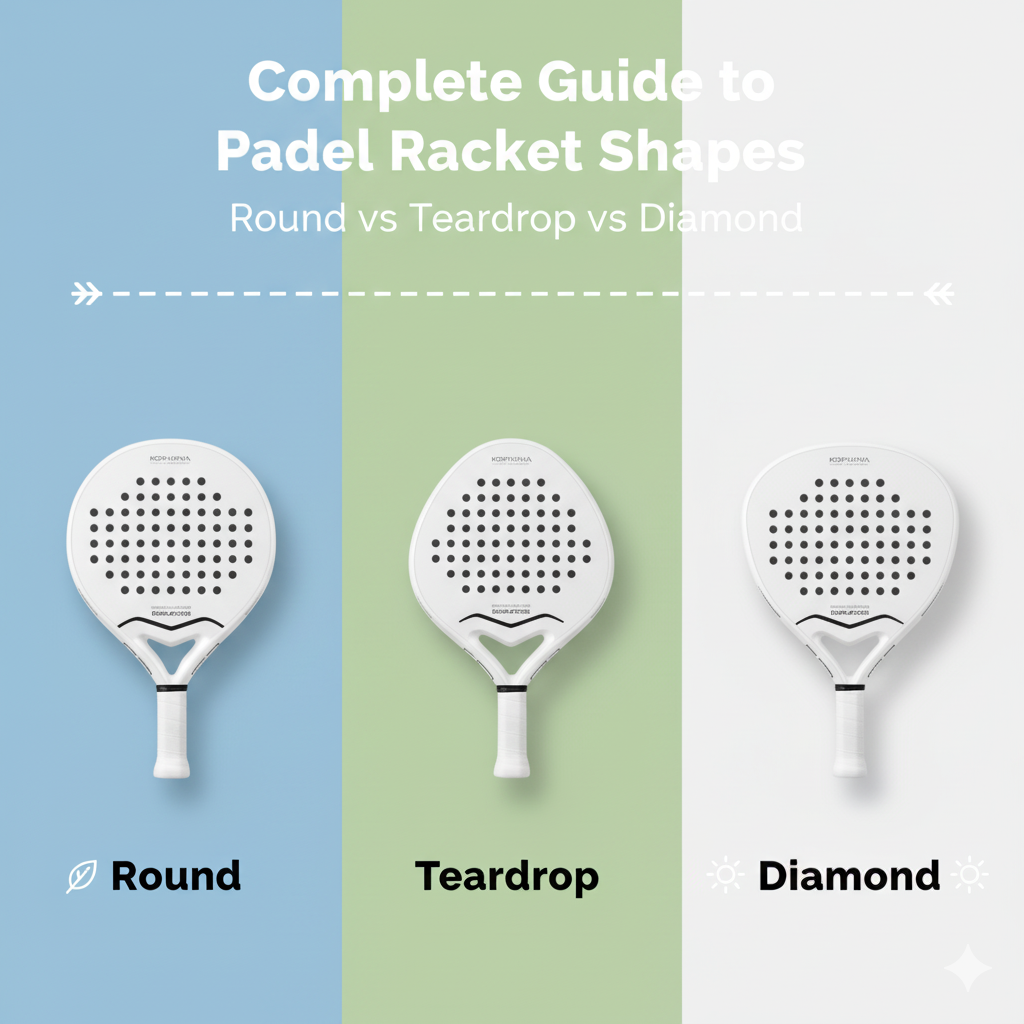
Understanding Racket Shapes
Before diving into each shape's characteristics, it's important to understand the fundamental anatomy of a padel racket and how shape affects performance.
Anatomy of a Padel Racket
Head Shape and Size: The overall shape of the racket head determines where weight is distributed and where the sweet spot is located. Round rackets have the largest head area, while diamond rackets have the smallest.
Sweet Spot Location: This is the optimal hitting area on the racket face. In round rackets, the sweet spot is high on the face. In diamond rackets, it's lower. Teardrop rackets place it in the middle-high area.
Balance Point: Shape affects where the racket's center of gravity is located. Round rackets typically have lower balance (weight toward handle), while diamond rackets have higher balance (weight toward head).
Weight Distribution: How weight is distributed affects maneuverability and power. Round shapes distribute weight more evenly, while diamond shapes concentrate weight in the head for power.
Round Shape Rackets
Round-shaped rackets are characterized by their circular or near-circular head shape, with the widest point near the middle of the racket face.
Characteristics
Largest Head Size: Round rackets have the largest hitting surface of all three shapes, providing more room for contact with the ball.
Highest Sweet Spot Location: The sweet spot is positioned high on the racket face, making it easier to reach and use during normal swings.
Most Balanced Weight Distribution: Weight is distributed more evenly throughout the racket, creating a balanced feel.
Largest Sweet Spot Area: The optimal hitting zone is larger than in other shapes, providing more forgiveness on off-center hits.
Performance Profile
Round rackets excel in control and forgiveness while offering moderate power:
Best For
Round rackets are ideal for:
Pros and Cons
Advantages:
Disadvantages:
Real Racket Examples
The Babolat Contact exemplifies round shape characteristics with its control rating of 92 and sweet spot rating of 88. Similarly, the Head Zephyr Pro demonstrates how round shapes provide excellent maneuverability (88 rating) while maintaining high control (90 rating).
Teardrop Shape Rackets
Teardrop-shaped rackets feature a head that's wider at the top and narrower toward the bottom, creating a balanced middle ground between round and diamond shapes.
Characteristics
Medium Head Size: Teardrop rackets offer a moderate hitting surface—larger than diamond but smaller than round.
Medium-High Sweet Spot: The sweet spot is positioned in the middle-high area of the racket face, offering a compromise between round and diamond.
Balanced to High Balance: Weight distribution can vary, but teardrop rackets often have medium to high balance points.
Medium Sweet Spot Area: The optimal hitting zone is moderate—larger than diamond but smaller than round.
Performance Profile
Teardrop rackets offer balanced performance across all categories:
Best For
Teardrop rackets suit:
Pros and Cons
Advantages:
Disadvantages:
Real Racket Examples
The Babolat Air Viper showcases teardrop versatility with balanced ratings: power 82, control 88, and maneuverability 85. The Bullpadel Flow demonstrates how teardrop shapes provide excellent all-around performance with ratings in the 80-85 range across all categories.
Diamond Shape Rackets
Diamond-shaped rackets feature a head that's wider at the bottom and narrower at the top, concentrating weight in the lower portion of the racket head.
Characteristics
Smallest Head Size: Diamond rackets have the most compact hitting surface, requiring more precision.
Lowest Sweet Spot Location: The sweet spot is positioned low on the racket face, near the bottom of the head.
High Balance Point: Weight is concentrated in the head, creating a high balance point that maximizes power.
Smallest Sweet Spot Area: The optimal hitting zone is the smallest of all three shapes, demanding precise contact.
Performance Profile
Diamond rackets prioritize power above all else:
Best For
Diamond rackets are designed for:
Pros and Cons
Advantages:
Disadvantages:
Real Racket Examples
The Bullpadel Vertex 04 exemplifies diamond shape power with a power rating of 98 and control rating of 72. The Babolat Technical Viper demonstrates how diamond shapes deliver maximum power (95 rating) while requiring advanced technique to control effectively.
Visual Comparison
To help visualize the differences, here's how the three shapes compare:
Side-by-Side Comparison
| Characteristic | Round | Teardrop | Diamond | |----------------|-------|----------|---------| | Head Size | Largest | Medium | Smallest | | Sweet Spot Location | High | Medium-High | Low | | Sweet Spot Size | Largest | Medium | Smallest | | Balance Point | Low | Medium-High | High | | Power Rating | 40-60 | 65-80 | 85-100 | | Control Rating | 90-100 | 70-85 | 50-70 | | Maneuverability | 80-95 | 70-85 | 50-70 | | Best For | Beginners | Intermediate | Advanced |
Power vs Control Spectrum
If we imagine a spectrum from maximum control to maximum power:
Most players will find their ideal position somewhere on this spectrum based on their skill level and playing style.
Real Racket Examples by Shape
Round Shape Examples:
Teardrop Shape Examples:
Diamond Shape Examples:
Shape Selection Guide
Choosing the right shape depends on several factors. Here's how to match shape to your needs:
Choosing Based on Skill Level
Beginners: Start with round shapes. The large sweet spot and high control make learning much easier. You'll develop proper technique faster with a forgiving racket.
Intermediate Players: Teardrop shapes offer the best balance. You've developed fundamentals and can handle slightly more demanding equipment while gaining versatility.
Advanced Players: Diamond shapes become viable. With solid technique, you can take advantage of the power while compensating for reduced control through skill.
Choosing Based on Playing Style
Defensive Players: Round or teardrop shapes work best. You need control and consistency more than explosive power.
Balanced Players: Teardrop shapes are ideal. They offer versatility for both defensive and aggressive play.
Aggressive Players: Diamond or teardrop shapes suit your style. Diamond if you have the technique, teardrop if you want more forgiveness.
Choosing Based on Physical Attributes
Arm Strength: Stronger players can handle high-balance diamond rackets. Average strength suits teardrop or balanced round. Less strength benefits from low-balance round rackets.
Swing Speed: Fast swings work well with diamond shapes. Moderate swings suit teardrop. Slower swings benefit from round shapes.
Court Position: Net players often prefer round or teardrop for quick reactions. Baseline players can use teardrop or diamond depending on skill. All-court players typically choose teardrop.
Common Misconceptions
Several myths persist about racket shapes. Let's clarify the reality:
"Diamond Shapes Are Always Better"
Reality: Diamond shapes are better for advanced players seeking maximum power, but they're worse for beginners and control-focused players. "Better" depends entirely on your skill level and playing style.
"Round Shapes Are Only for Beginners"
Reality: While round shapes are ideal for beginners, many advanced defensive players prefer them for their control and consistency. Professional players use round rackets when precision matters more than power.
"Shape Doesn't Matter If You're Strong"
Reality: Strength helps with high-balance rackets, but shape affects sweet spot location, control, and maneuverability—factors that strength alone can't overcome. Technique and shape compatibility matter more than raw strength.
"You Can't Play Aggressively with Round"
Reality: While round rackets don't offer maximum power, skilled players can play aggressively with them through technique, timing, and positioning. Power isn't the only path to aggressive play.
Hybrid and Special Shapes
Some manufacturers experiment with shape variations, though the three main shapes dominate the market:
Specialized Shapes
Occasionally, brands introduce slight variations—wider teardrops, modified diamonds, or elongated rounds. These typically offer minor performance tweaks rather than fundamental differences.
How Manufacturers Modify Shapes
Brands may adjust:
These modifications create subtle performance differences between brands while maintaining the core characteristics of each shape type.
Key Takeaways
Conclusion
Understanding padel racket shapes is fundamental to choosing the right equipment. Round shapes offer maximum control and forgiveness, making them ideal for beginners. Teardrop shapes provide balanced performance for intermediate players seeking versatility. Diamond shapes deliver maximum power for advanced players with solid technique.
The shape you choose should match your current skill level, playing style, and physical attributes. Don't be tempted to use an advanced diamond racket before you're ready—it will hinder rather than help your development. Similarly, don't hesitate to upgrade from round to teardrop or diamond as your skills improve.
Ready to find rackets in your preferred shape? Browse our complete racket collection and filter by shape to see all available options. For more guidance, check out our beginner's guide if you're just starting, or our advanced player guide if you're considering diamond shapes.
Remember, the right shape makes the game easier and more enjoyable. Choose wisely, and your racket will become a true extension of your game.