Padel Racket Buying Mistakes to Avoid: Learn from Common Errors
Author: Carlos Rodriguez
Padel Racket Buying Mistakes to Avoid: Learn from Common Errors
Author: Carlos Rodriguez
Introduction
Buying a padel racket is an important decision that affects your performance, enjoyment, and development in the sport. Unfortunately, many players make common mistakes that lead to poor equipment choices, wasted money, and frustration on the court. Learning from these mistakes helps you avoid them and make better decisions.
The most common buying mistakes stem from misconceptions, lack of information, or following advice that doesn't apply to your situation. Understanding what not to do is just as important as knowing what to do when selecting equipment.
In this comprehensive guide, we'll explore:
- Buying based solely on price without considering fit
- Choosing rackets for your future skill level instead of current ability
- Ignoring personal feel and relying only on specifications
- Following trends blindly without evaluating your needs
- Not testing rackets before buying when possible
- Other common mistakes that lead to poor equipment choices
- Price doesn't guarantee fit: A cheap racket that doesn't match your needs provides poor value, while an expensive racket that doesn't fit is a waste of money.
- Value is relative: The best value comes from rackets that match your needs within your budget, not the cheapest or most expensive option.
- Performance-price relationship: The relationship between price and performance isn't linear—diminishing returns set in, and personal fit matters more than price.
- Long-term costs: A poorly chosen cheap racket may need replacement sooner, while an expensive mismatch wastes money immediately.
- Set a budget range, then find the best-fitting racket within that range
- Focus on characteristics that match your needs, not just price
- Consider long-term value, not just initial cost
- Evaluate whether price differences justify performance differences for you
- Technique requirements: Advanced rackets require techniques you may not have yet, leading to poor performance and frustration.
- Learning curve: Using equipment beyond your ability can hinder skill development rather than accelerate it.
- Frustration and demotivation: Struggling with inappropriate equipment can reduce enjoyment and motivation to improve.
- Delayed progress: Equipment that's too advanced may actually slow your development by making fundamentals harder to learn.
- Choose rackets that match your current skill level
- Select equipment that supports your development
- Plan to upgrade as your skills improve
- Focus on learning with appropriate equipment first
- Specifications don't tell the whole story: Two rackets with similar specifications can feel completely different.
- Personal preference matters: What feels right varies significantly between individuals based on physical attributes, technique, and preferences.
- Feel affects confidence: A racket that doesn't feel right reduces confidence and performance, regardless of its specifications.
- Comfort impacts play: Discomfort or awkward feel distracts from performance and can lead to technique problems.
- Test rackets when possible to evaluate feel
- Pay attention to how rackets feel in your hands and during swings
- Consider comfort and confidence along with specifications
- Trust your instincts about what feels right
- Trends may not fit you: Popular rackets are popular for reasons that may not apply to your situation.
- Individual differences: What works for others may not work for you due to differences in skill, style, or preferences.
- Marketing influence: Trends are often driven by marketing rather than genuine performance benefits for all players.
- Missing better options: Following trends may cause you to overlook rackets that would work better for you.
- Evaluate trends critically—understand why they're popular
- Consider whether trend reasons apply to you
- Test trend rackets along with alternatives
- Choose based on your needs, not popularity
- Feel is personal: Reviews can't tell you how a racket will feel for you specifically.
- Specifications are incomplete: Numbers don't capture important characteristics like feel, balance perception, or comfort.
- Unexpected issues: Testing reveals problems you wouldn't discover from specifications alone.
- Wasted money risk: Buying untested rackets increases the risk of poor choices and wasted money.
- Test rackets whenever possible before buying
- Try multiple options to compare feel and performance
- Pay attention to how rackets feel during actual play, not just holding them
- Use testing to narrow choices, then research finalists
- Balance matters: Rackets are systems where all characteristics work together—focusing on one ignores important interactions.
- Trade-offs exist: Emphasizing one characteristic often means sacrificing others that may be important.
- Context is key: How characteristics work together matters more than individual values.
- Missing the big picture: Overemphasizing one factor can lead to choices that don't work well overall.
- Consider all characteristics together
- Understand how characteristics interact
- Evaluate overall fit, not just individual factors
- Balance multiple considerations
- Style-racket mismatch: Defensive players using power-focused rackets (or vice versa) struggle to play their natural game.
- Wasted potential: Rackets excel when they match playing style—mismatches waste both racket potential and player ability.
- Frustration: Playing against your racket's characteristics creates frustration and reduces enjoyment.
- Performance limits: Style mismatches limit performance regardless of racket quality.
- Understand your playing style clearly
- Choose rackets that support your style
- Match racket characteristics to your approach
- Test to ensure style compatibility
- Brand diversity: Brands produce wide ranges of rackets with different characteristics—brand doesn't guarantee fit.
- Missing good options: Limiting yourself to one brand may cause you to miss better-fitting rackets from others.
- Brand reputation limitations: Reputation reflects overall quality but doesn't guarantee individual racket fit.
- Personal fit matters more: How a racket fits you matters more than which brand made it.
- Evaluate each racket individually
- Test rackets from multiple brands
- Focus on fit over brand
- Use brand reputation as one factor, not the only factor
- Hidden costs: Some rackets require more maintenance or have higher long-term costs.
- Durability differences: Rackets vary in durability, affecting long-term value.
- Maintenance burden: High-maintenance rackets may not fit your lifestyle or preferences.
- Total cost of ownership: Initial price is only part of the total cost—maintenance and replacement matter too.
- Consider maintenance requirements
- Evaluate durability expectations
- Factor in long-term costs
- Choose rackets that fit your maintenance preferences
- Missing information: Rushing prevents gathering information needed for good decisions.
- No comparison: Quick decisions often mean not comparing options.
- Regret risk: Hasty choices increase the likelihood of regret and poor fit.
- Wasted money: Poor quick decisions waste money that could have been spent better with more time.
- Take time to research options
- Test multiple rackets when possible
- Compare characteristics and feel
- Make informed decisions rather than rushed ones
- Racket characteristics and how they affect performance
- Your own needs, skill level, and playing style
- Available options in your budget
- Reviews and recommendations (with critical evaluation)
- Your current skill level
- Your playing style
- Your preferences and priorities
- Your budget and value considerations
- Try several rackets
- Compare feel and performance
- Test in actual playing conditions
- Evaluate comfort and confidence
- Notice how rackets feel
- Evaluate comfort
- Assess confidence
- Trust your instincts
- How well rackets match your needs
- Feel and comfort
- Value and budget fit
- Long-term considerations
- Your research and testing
- Your needs and preferences
- Value considerations
- Informed judgment
- Price alone doesn't determine value: Focus on fit within your budget rather than cheapest or most expensive options.
- Match equipment to current ability: Choose rackets for your current skill level, not your aspirations.
- Personal feel matters: Test rackets when possible and trust how they feel to you.
- Evaluate trends critically: Don't follow trends blindly—consider whether they apply to you.
- Test before buying: Whenever possible, test rackets to evaluate feel and performance.
- Consider all factors: Don't overemphasize single characteristics—evaluate rackets holistically.
- Match your playing style: Choose rackets that support your natural playing style.
- Evaluate each racket individually: Don't assume brand reputation guarantees individual racket fit.
- Consider long-term costs: Factor in maintenance, durability, and total cost of ownership.
- Take your time: Make informed decisions rather than rushing—good choices are worth the time investment.
- How to Choose a Padel Racket Based on Your Playing Style
- Padel Racket Buying Guide: Price Ranges and Value 2025
- 10 Common Padel Racket Myths Debunked
- Browse All Rackets
- View All Guides
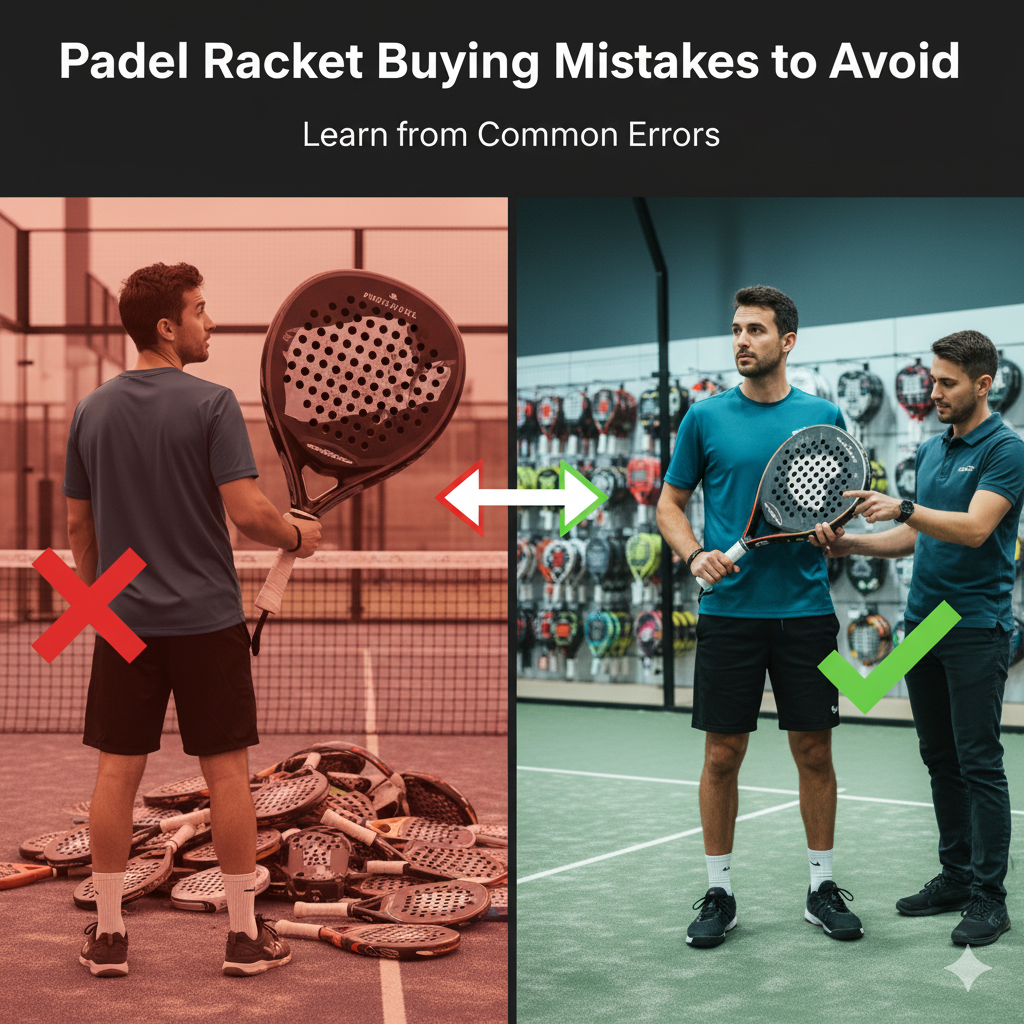
!Padel Racket Buying Mistakes to Avoid: Learn from Common Errors
Mistake 1: Buying Based on Price Alone
The Mistake: Choosing a racket primarily or solely based on price, assuming cheaper means better value or more expensive means better performance.
Why It's Problematic:
What to Do Instead:
Mistake 2: Choosing for Your Future Skill Level
The Mistake: Buying a racket designed for a skill level you hope to reach rather than your current ability, assuming you'll "grow into it."
Why It's Problematic:
What to Do Instead:
Mistake 3: Ignoring Personal Feel
The Mistake: Relying solely on specifications, ratings, or recommendations without considering how the racket actually feels when you use it.
Why It's Problematic:
What to Do Instead:
Mistake 4: Following Trends Blindly
The Mistake: Choosing rackets because they're popular, recommended by others, or used by professionals without evaluating whether they match your needs.
Why It's Problematic:
What to Do Instead:
Mistake 5: Not Testing Before Buying
The Mistake: Buying rackets without testing them first when testing opportunities are available, relying only on reviews or specifications.
Why It's Problematic:
What to Do Instead:
Mistake 6: Overemphasizing Single Characteristics
The Mistake: Focusing too heavily on one characteristic (like power rating, weight, or shape) while ignoring other important factors.
Why It's Problematic:
What to Do Instead:
Mistake 7: Ignoring Playing Style
The Mistake: Choosing rackets without considering your playing style, assuming any good racket will work for any style.
Why It's Problematic:
What to Do Instead:
Mistake 8: Buying Based on Brand Alone
The Mistake: Assuming all rackets from a preferred brand will work for you, or avoiding brands you don't know.
Why It's Problematic:
What to Do Instead:
Mistake 9: Neglecting Maintenance Considerations
The Mistake: Choosing rackets without considering maintenance requirements, durability, or long-term costs.
Why It's Problematic:
What to Do Instead:
Mistake 10: Rushing the Decision
The Mistake: Making quick buying decisions without adequate research, testing, or consideration.
Why It's Problematic:
What to Do Instead:
How to Avoid These Mistakes
Following a systematic approach helps you avoid common buying mistakes.
Research Phase
Gather Information: Learn about:
Understand Your Needs: Clearly identify:
Testing Phase
Test Multiple Options: When possible:
Pay Attention to Feel: During testing:
Decision Phase
Consider All Factors: Evaluate:
Make Informed Choices: Base decisions on:
Key Takeaways
Related Content
Conclusion
Avoiding common buying mistakes helps you make better equipment decisions that support your performance, enjoyment, and development. The key is to take a systematic approach: research your needs and options, test when possible, evaluate holistically, and make informed decisions based on fit rather than assumptions.
Remember, the best racket for you is one that matches your current skill level, supports your playing style, feels right when you use it, and provides good value within your budget. Avoid the temptation to take shortcuts, follow trends blindly, or make hasty decisions. Taking time to make the right choice pays off in better performance and greater enjoyment.
Ready to make an informed racket choice? Browse our complete racket collection with detailed reviews, ratings, and expert recommendations. Our reviews help you understand how different rackets perform and which characteristics match various needs, helping you avoid common mistakes and make better decisions.
Your perfect racket is out there—avoiding these mistakes helps you find it faster and with more confidence.